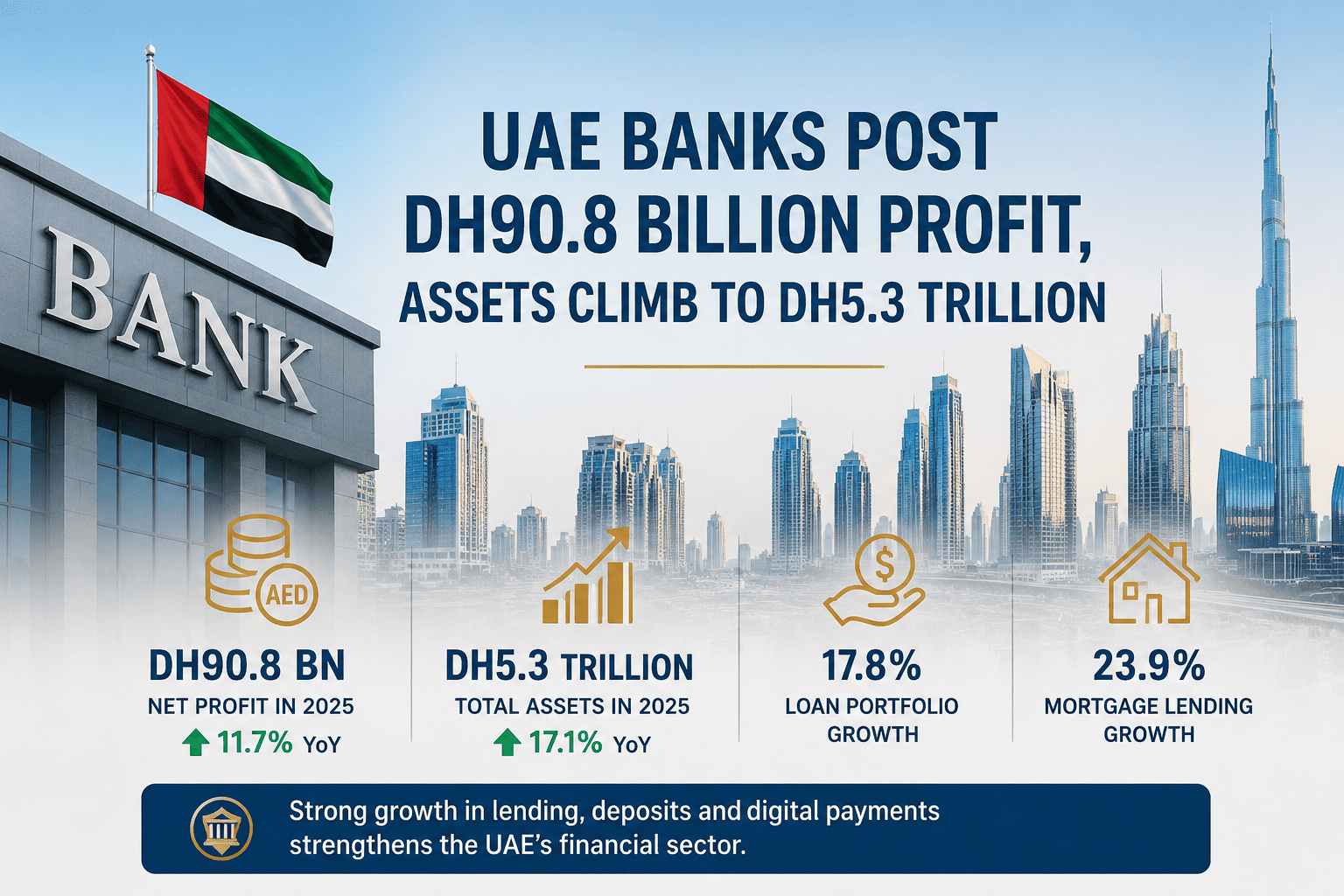
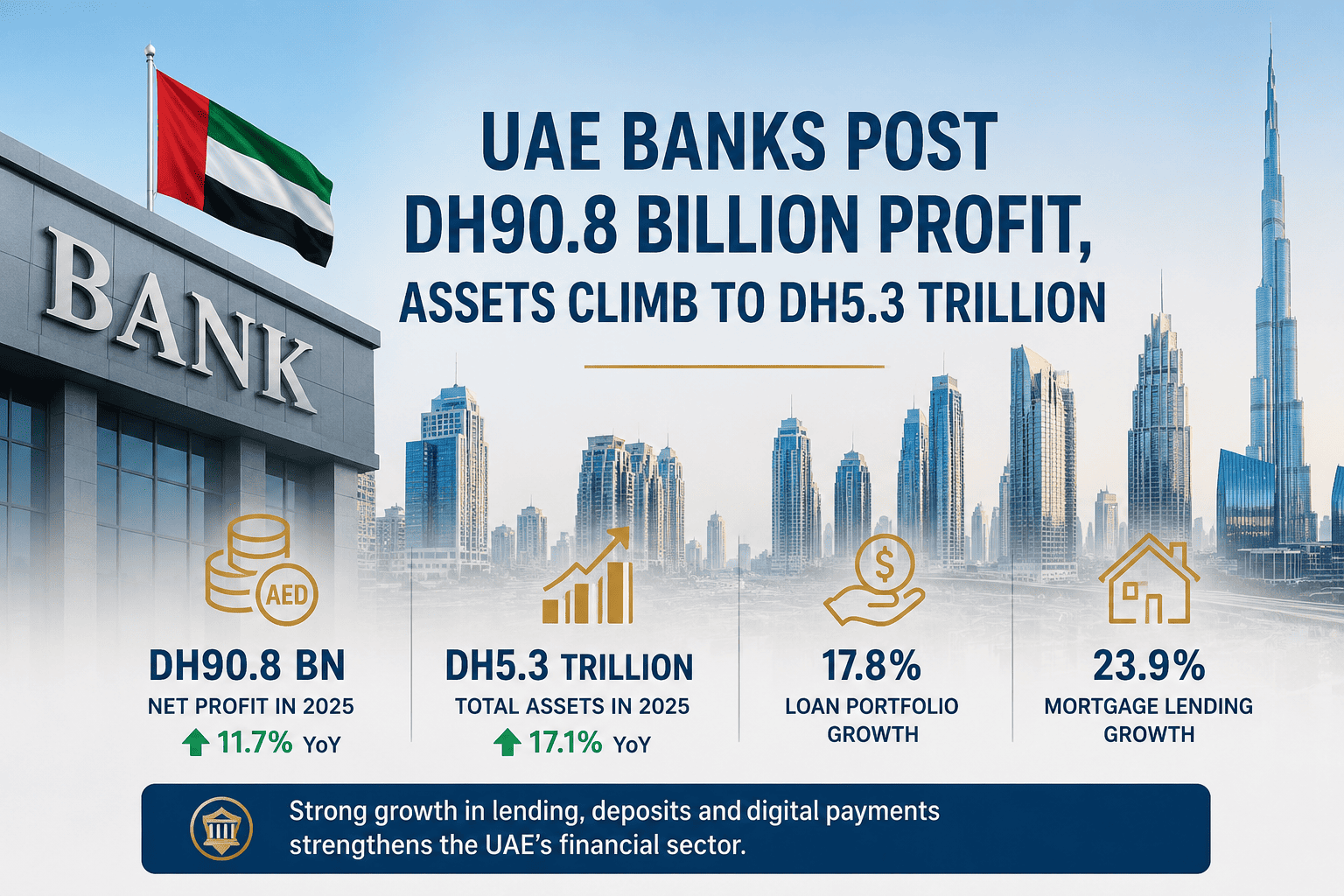
The UAE banking sector recorded strong financial growth in 2025, with total net profits reaching Dh90.8 billion, an increase of 11.7% compared with the previous year. Total banking-sector assets also climbed 17.1% to Dh5.3 trillion, highlighting the continued strength and resilience of the UAE’s financial system.
According to the Central Bank of the UAE (CBUAE) Financial Stability Report 2025, the banking sector benefited from higher domestic lending, stronger deposits and continued economic activity across the country.
Loans and deposits continue to grow
The UAE banking system’s overall loan portfolio expanded by 17.8% during 2025, supported mainly by increased lending to retail customers and private companies.
Deposits also recorded significant growth, rising 16.1% during the year. Retail deposits increased by 13.8%, while deposits from private corporations grew by 22.8%. Resident deposits represented 88.6% of the total increase, reflecting strong domestic liquidity within the banking system.
Mortgage lending records strong growth
One of the key highlights of the report was the continued expansion of mortgage finance in the UAE.
Mortgage lending grew by 23.9% during 2025, while the average loan-to-value ratio for new mortgage commitments remained around 60%.
The banking system's loan-to-deposit ratio increased moderately from 76.6% in 2024 to 77.7% at the end of 2025, indicating continued lending activity alongside strong deposit growth.
For the UAE property market, the increase in mortgage lending reflects continued demand for residential real estate and financing from homebuyers and investors.
Asset quality and capital strength improve
The UAE banking sector also strengthened its asset quality during the year. The non-performing loan ratio declined to 3.3%, compared with 4.7% in 2024 and 8.2% in 2020.
Banks maintained strong capital buffers, with the banking system's Capital Adequacy Ratio at 17.0% and its Common Equity Tier 1 (CET1) ratio at 14.4% at the end of 2025.
Bank profitability rises
The sector's net profit reached Dh90.8 billion, supported by a 12.5% increase in total operating income.
At the same time, the banking sector's net interest margin moderated to 2.3%, compared with 2.5% in 2024. The cost-to-income ratio also improved from 31.5% to 30.5%, indicating greater operational efficiency.
UAE banks remain resilient under stress
The CBUAE's supervisory stress tests showed that UAE banks remained above minimum regulatory capital requirements even under a severe adverse scenario.
Under the stress scenario, the aggregate CET1 ratio declined from 14.1% to a low of 11.1%, but remained above regulatory minimum requirements.
Liquidity stress tests also indicated strong liquidity buffers, with estimated surpluses of approximately Dh462 billion over 30 days and Dh371 billion over 60 days.
Digital payments continue to expand
The UAE's digital payment ecosystem also recorded substantial growth in 2025.
Transaction volumes on Aani, the UAE's Instant Payment Platform, increased by approximately 183% compared with 2024. The number of registered customers surpassed 11.7 million by the end of 2025.
Aani enables customers to make instant transfers of up to Dh50,000, 24 hours a day, while also supporting QR payments, payment requests and split-payment features.
The UAE's national payment switch processed more than two million card transactions every day, while preparations continued for the introduction of Jaywan debit and prepaid cards from 2026.
What this means for the UAE property market
The strong growth in mortgage lending, deposits and banking-sector assets provides another positive indicator for the UAE's real estate market.
With mortgage lending rising nearly 24%, banks are continuing to support homebuyers and property investors through increased access to financing. Combined with strong economic activity and improving asset quality, the banking sector's performance reinforces the UAE's position as a major regional financial and investment hub.
Overall, the 2025 figures demonstrate a well-capitalised and resilient UAE banking sector, supported by strong liquidity, growing lending activity and increasing adoption of digital payments.